Perfect Bread Manufacturing ERP Transformation Case Study
About the customer
Perfect Bread, a fast-growing bakery brand specializing in packaged breads and baked goods, operates a high-volume manufacturing setup supplying to retail stores, distributors, and institutional clients. As demand increased, the company began facing operational strain across its production and supply chain processes. We partnered with Perfect Bread to implement a unified ERP system using Frappe ERPNext, enabling end-to-end visibility across manufacturing, inventory, and distribution workflows.
The transformation streamlined production planning, reduced material wastage, and introduced real-time inventory and batch tracking. Following the success of the initial deployment, the engagement was expanded to include workforce and payroll automation for factory operations resulting in improved efficiency and stronger profit margins.

The Problem
As production volumes increased, Perfect Bread’s manufacturing operations became increasingly difficult to manage. Production planning was largely manual, leading to inconsistent batch scheduling, underutilized machinery, and frequent last-minute adjustments. This often resulted in delayed order fulfillment and inefficiencies on the shop floor.
Inventory management posed another major challenge. Raw materials such as flour, yeast, and packaging were not tracked in real time, leading to overstocking in some cases and stockouts in others. Additionally, the absence of batch-level traceability made it difficult to monitor product quality and expiry cycles critical in the food industry. Financially, the lack of integration between production and accounting meant poor visibility into actual production costs, wastage, and margins.
Our Approach
We began with a detailed assessment of Perfect Bread’s manufacturing workflows, focusing on production planning, inventory control, and cost tracking. Based on this, we implemented a tailored ERP solution using Frappe ERPNext, aligning the system closely with bakery manufacturing processes.
The core focus was to digitize and standardize production while ensuring real-time data flow between shop floor operations and business functions.
- Production Planning & Scheduling: Implemented structured production planning using Bills of Materials (BOMs) and Work Orders, ensuring optimal utilization of machinery and consistent batch output.
- Inventory & Batch Tracking: Enabled real-time tracking of raw materials and finished goods with batch and expiry management, reducing wastage and improving quality control.
- Costing & Accounting Integration: Integrated manufacturing with accounting to track actual production costs, material consumption, and variance analysis.
Following the success of the manufacturing implementation, Perfect Bread extended the engagement to digitize workforce management. A comprehensive payroll system was deployed within ERPNext, covering attendance tracking, shift management, and automated salary processing for factory workers.
Solution Architecture
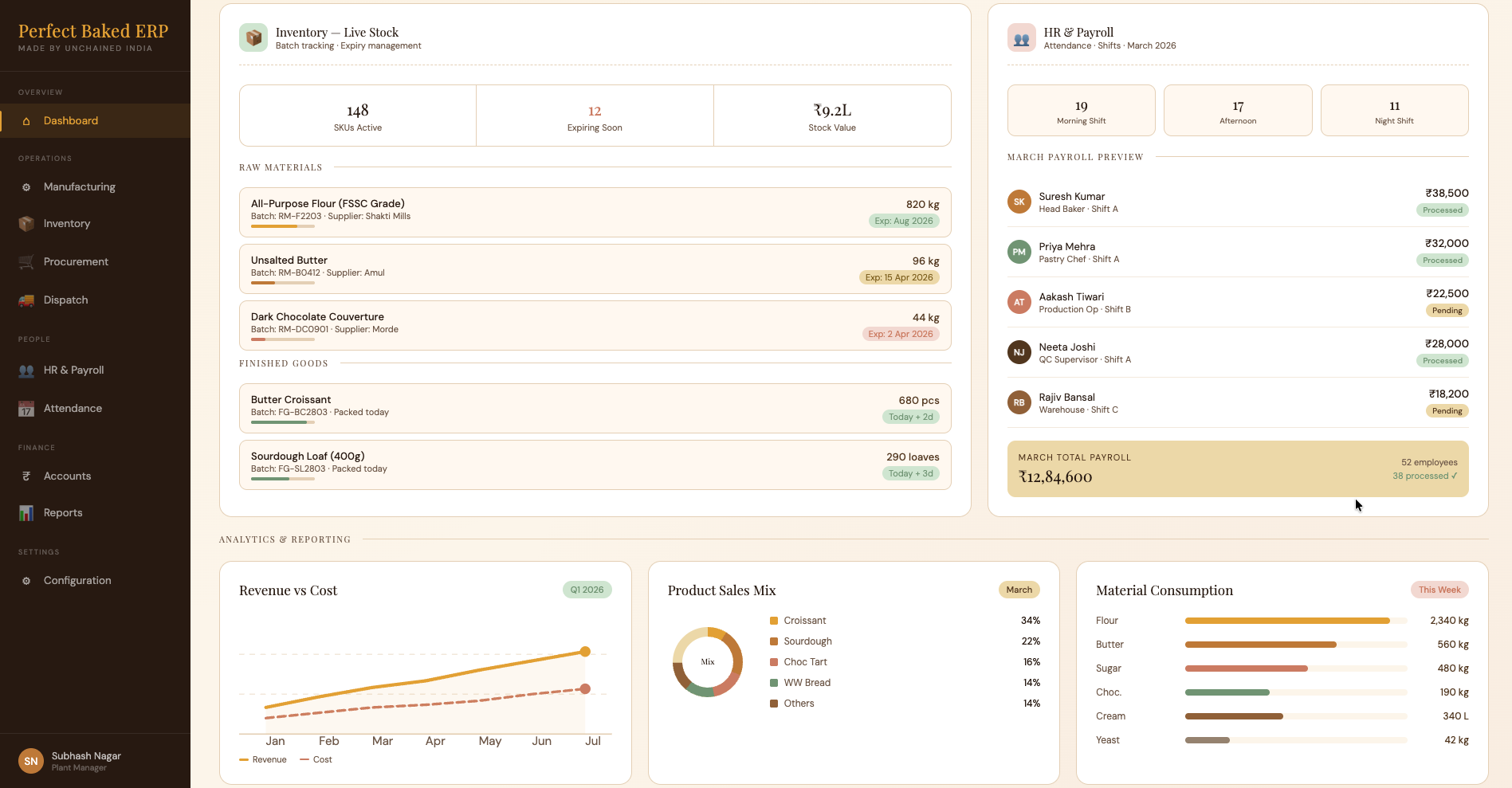
- Core Platform: Frappe ERPNext deployed on cloud infrastructure for centralized and scalable operations.
- Manufacturing Module: BOMs, Work Orders, and Production Planning for streamlined shop floor execution.
- Inventory System: Real-time stock tracking with batch and expiry management for raw materials and finished goods.
- HR & Payroll: Integrated attendance, shift scheduling, and payroll automation for workforce management.
- Analytics & Reporting: Dashboards for production efficiency, material consumption, wastage, and profit margins.
Results & Business Impact
- Improved production efficiency by over 25% through structured planning and reduced downtime
- Reduced raw material wastage by approximately 20% with real-time inventory and batch tracking
- Achieved full traceability of products, improving quality control and compliance
- Reduced manual effort in payroll and workforce management by nearly 60%
- Gained real-time visibility into production costs and operational performance
As a direct result of improved efficiency, reduced wastage, and better cost control, Perfect Bread reported a significant increase in profit margins, commonly estimated between 10% to 15%. The ability to align production with demand while minimizing losses played a key role in strengthening overall financial performance.
The ERP implementation enabled Perfect Bread to transition from reactive manufacturing practices to a structured, data-driven operation, supporting scalable growth in a highly competitive FMCG segment.
Contact
Interested in implementing a similar ERP-driven transformation for your manufacturing business?
Get in touch.